Physical Address
304 North Cardinal St.
Dorchester Center, MA 02124
Physical Address
304 North Cardinal St.
Dorchester Center, MA 02124

MEET HARBORNATE II
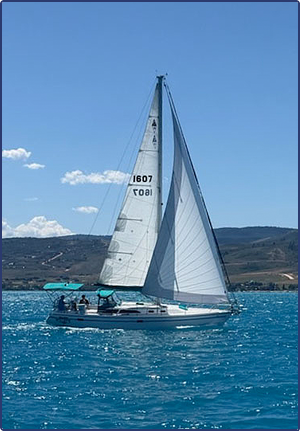
She is a Catalina 36 MKII

HER STORY
HER SPECIFICATIONS
She was launched in 1997 at the Catalina Yachts yard in California—hull number 1607. She measures 36 feet 4 inches on deck, with a beam of 11 feet 11 inches and a draft of 5 feet 10 inches. Her displacement is 14,000 pounds, and she carries 6,600 pounds of ballast. She is a masthead sloop with the standard spar, a walk-through transom, and a 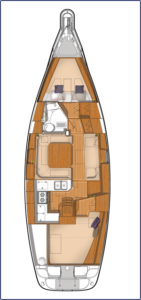 generous aft cockpit. Tank-age is 74 gallons of water and a scant 25 gallons of fuel—far too little for serious cruising. Her interior layout is classic for a boat of her size: a forward V-berth and head, a comfortable saloon and galley leading aft to the companionway, and a private aft stateroom with a double berth.
HOW SHE BECAME OURS
She began life as a charter boat in San Diego. After five years on the charter circuit she was purchased and brought to Bear Lake, where she has remained in fresh water ever since. We are her fourth owners. We had already been sailing Bear Lake for some time aboard Harbornate when we heard a rumor that her owners had retired and were selling everything to move to Mexico. We approached Mike and Susie Carlisle and asked if they might be interested in selling. Mike said “maybe”; Susie said “absolutely not.” We let the matter drop. Then in February the phone rang. Mike asked if we were still interested. We said yes while trying hard to contain our excitement. By the end of the month she was ours—no sea trial, no survey. Over the next six months, as we came to know her, we discovered we could fall deeply in love with a boat. Not that we didn’t love our current boat but this was different, we were home. We had been fond of the name Harbornate, so we christened her Harbornate II.
WE CAN’T HELP IT
She was not in the best of condition. Somewhere along the way someone had decided that snaps were the answer to every fastening problem. Our first goal was to restore her to as-new condition. Gelcoat work was an easy place to begin; we filled more than 140 holes left by snap screws. The interior millwork also needed attention. One of the quiet virtues of Catalina design is that the woodwork comes out in discrete components, so we could remove one section at a time, bring it home to the shop, and rebuild it properly. This was our third vessel to refit, and this time we kept a detailed project log. It has been remarkable to watch that list grow year after year—easy to forget just how much work accumulates over the seasons.
After five or six years we felt she was finally back to original condition. Almost at once we decided to make her better than new. Our first major decision was to convert the interior to all-teak joinery for a warmer, cozier feel. In the head—where Catalina traditionally fitted wooden doors and a shower curtain—we created a true wet head with folding acrylic panels to protect the remaining woodwork, installed a proper shower head, and painted the countertop to match the rest of the space. We rebuilt the electrical panel, which led us deep into the boat’s wiring. Electronics were upgraded to a modern chart plotter, and the helm and engine controls were completely redesigned. Every repair or improvement seemed to reveal another item that needed attention. The full list of upgrades is far too long to recount here.
 CHANGING COURSE
Then in early 2026 I retired, and our course changed. As her name has always hinted, we had long dreamed of taking the boat to the coast so we could spend our winters in warmer latitudes. Shortly after I swallowed the anchor, that dream began to take real shape. At first we told no one, uncertain whether it could ever happen. The more we looked into it, the clearer it became that she had been designed for weekend sailing, not for extended time on the hook. The list of necessary upgrades was daunting; when we added up the costs, the numbers suggested the dream would remain just that. When cross-country costs threatened to ground our dreams, we kept searching and praying for a way forward, holding onto the hope that things would work out. The answer came in the most unexpected way. A true friend—someone for whom I hold the deepest affection and respect—reached out with a life-changing gesture of support. Out of respect for their privacy, we are keeping the details close to our hearts, but we want to acknowledge their profound generosity. Their grace put the wind back in our sails.
PREPARING FOR THE FUTURE
Here is a brief list of some of the upgrades or additions we needed to make for the journey.
New rigging, our rigging is now 28 years old, long over due.
Solar panels with a lithium battery system. We are going from 100 Ah to 460 Ah. More power mean more comfort.
Eight Jerry cans to compensate for the low fuel volume on board. These will store on deck.
A new windlass and all chain rode. The old one just wasn’t strong enough to lift over 200 lbs of chain and anchor. A stronger, more relabel autopilot. AIS – a must have for sailing around commercial traffic. Radar and tower to allow us to see in the dark. Star-link to stay in touch. Davits to easily store the dinghy. And a large list of safety equipment such as, new life jackets with personal EPERBs, Jack line with tethers, Ditch bag, and new fire extinguishers.
We had to reinstate the boats registration with the U.S. coastguard and get a MMSI (Maritime Mobile Service Identity) number and a Ship Station License from the FCC to be programed into our new VHF and AIS system.
We are currently about half way through getting the boat ready, the big hurdles is getting the boat to Georgia.
